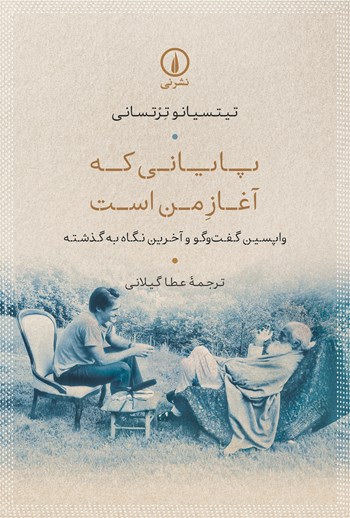
Anahid Khazir speaks with Ata Gilani about Tiziano Terzani, journalism and history
Ata Gilani:
Thank you for giving me this opportunity to speak to the readers of the book.
My relationship with the Terzanis—father and son—has always been more personal and emotional than professional. When I first came across Tiziano, not much time had passed since his death. I found myself looking into his eyes on the cover of the book, and something about them felt familiar. I had previously followed his articles in Der Spiegel. His was the gaze of a man who had seen much of the world and had many stories to tell.
The German edition was a substantial volume. For several days I could hardly put it down. It made a deep impression on me, and I recommended it to many friends and colleagues. As a writer, Terzani had worn out a few more shirts than I had—if I may preserve the Persian expression. As a political and social activist, he had travelled much the same road as my generation and I.
In his own part of the world—in Europe and the Far East—he was, in a sense, what we Iranians call a “Fifty-Sevener”: someone shaped by the hopes, passions and disillusionments surrounding Iran’s 1979 revolution. He was like us, with similar aspirations, convictions and mistakes, large and small. The difference was that he had been born in Florence rather than Rasht or Tehran, and that instead of Persian he spoke and wrote in Italian, English, German and Chinese. I could not bear the thought that Persian-speaking readers should be denied the ideas and experiences of such a widely travelled man.
How does a journalist’s perspective differ from that of a historian when reporting events?
Both are narrators. A journalist tells the story of an event as it unfolds, whereas a historian pays closer attention to what came before it and what followed. In historical analysis, the wider context of time carries greater weight. Journalism is closer to chronicling events than to writing history—if we wish to split hairs!
Journalism itself, of course, takes many forms. Analytical and investigative journalism are quite different from simply transmitting a news item. Even so, no narrative is entirely free of perspective. Everyone looks at a landscape from a particular angle. Even our two eyes do not see from precisely the same viewpoint—let alone the distance separating objectivity from subjectivity, the object from the observing subject. The simplest news item can be presented in a slightly more objective or slightly more subjective way.
But let us not confuse two separate matters. There is a considerable difference between a false and malicious report and an account that reaches us through the narrator’s own perspective, after passing through the filters of emotion, belief and inclination. I cannot describe every aspect of that distinction here, but let me offer an example.
Water flowing from a spring passes through many streams before reaching us. Along the way it acquires different colours and smells, and sometimes impurities. The water may ultimately taste pleasant or unpleasant, but no one has the right to poison it deliberately. An old Persian maxim applies here:
“One must speak nothing but the truth; but not every truth must be spoken.”
Why is it important for a journalist to understand history—or, conversely, for a historian to understand journalism?
Let us take the answer from Terzani himself, who was both a historian and a journalist. In the Persian edition of the book, he says:
“Anyone who does not follow the events of the day within their historical context will understand nothing. […] Anyone who fails to understand history will also fail to understand his own age. A journalist who describes current events but remains confined to them is like someone viewing the world through a microscope, when what you need in order to see into the distance is a telescope.”
To the essential ingredients in every journalist’s kitchen, let us therefore add geography, sociology, psychology, anthropology, archaeology—and a few generous ladlefuls of philosophy!
Whether we are dealing with a historical essay or a few lines of newsprint, the finished piece is never identical to the raw account that reaches a journalist or historian by telephone or telex. Those few lines of information, or a single photograph, are raw ingredients. They must be cooked in your stockpot and made appetising and digestible. They must reach the consumer promptly, hot and fresh—and they must never, under any circumstances, be poisoned.
By poison, I mean lies and slander, and contamination by the germs of hypocrisy, flattery and deliberate deception.
Where is the boundary between news, historical narrative and media-generated mythology?
Let us begin by considering the origins of these three terms.
One Persian word for “news” is payām, meaning “message”, and it is related to pey, a path or track. A messenger—or a prophet—saw or knew something inaccessible to others because they were separated from it by time or distance. By the very nature of his task, the messenger was expected to deliver the message without the slightest alteration.
Unfortunately, this is impossible in practice. Something of the messenger’s personality and state of mind invariably travels with the message.
History, too, has not always been what we now imagine it to be. Herodotus’s Histories is a mixture of travel writing, accounts of conquest, geography, legend and storytelling, woven together to entertain and astonish its listeners. If this is how the “father of history” proceeded, we can imagine what became of his descendants.
The seven thousand pages of al-Tabari’s history are filled with phrases such as “the narrator relates”—although one may sometimes doubt not only the accuracy of the narration, but the very existence of the narrator.
Despite all this, I neither wish nor am able to question the necessity of history and historiography. Those scrolls, inscriptions, scraps of paper and books of uncertain reliability constitute our credentials. We possess no other mirror in which to see our own faces. We must try to recognise ourselves in these distorting mirrors, subjecting every reflection to rigorous verification.
The word “myth” has likewise mingled truth and falsehood from the beginning and fed the mixture to the multitude. Verification is neither required nor even possible. Ancient mythologies—Indian, Iranian and Greek—describe events and creatures that no reasonable person would accept as literally real.
Consider David and Goliath, the Epic of Gilgamesh, the Greek Odyssey or the Indian Mahabharata. Each reflects the dreams and nightmares of innumerable people, accumulated over countless generations. From a geological standpoint, it may no longer matter precisely when Noah’s flood occurred. Culturally and poetically, however, Saadi’s familiar verse remains meaningful:
“Noah’s son sat in the company of the wicked
and lost the honour of his prophetic house.”
The value and significance of every report, narrative and myth must therefore be judged within the context of its own time. What we now call “fake news” also existed in the past.
In some respects, people today may be better able to distinguish the genuine from the counterfeit. If, for example, you dismiss as false the story of the magicians’ staffs turning into serpents, people may also cease to believe that the waters of the Nile were parted. Yet, regrettably, these same people can still be deceived by a thousand lies, large and small. Call it propaganda if you like—or a war of narratives.
In this book, Terzani regards death not as an ending but as a beginning. Is his outlook rooted chiefly in Eastern mysticism, or in a form of Western existentialist philosophy?
We do not encounter only one Terzani in this book. He himself says:
“Everyone’s life follows a path. You can trace that path only when you are approaching its end. When you look back, the connections between its scenes and events become clear.”
We first meet an impoverished child, then a mischievous boy, and later an ambitious young man. Eventually, the river of his life—having wound through mountain passes and plunged over waterfalls—reaches the still lagoon of old age.
Terzani was neither always preoccupied with death nor permanently withdrawn from people. For as long as he could, he lived well, ate well, did good and kept the company of good people. When his wings could carry him no farther, he settled upon the ground of detachment. It was then that he could even laugh at death.
His attitude towards death came neither solely from Eastern mysticism nor solely from Western existentialism. It was a fusion of both. From the East, he had learnt serenity and acceptance; from the West, he had acquired the courage to think and to question.
Journalism had taught him that no truth is absolute. In the solitude of his final days, he discovered that even death is a form of being. Colourlessness, too, is a colour.
When he speaks of “the end” as “my beginning”, he no longer regards death as an enemy, but as a part of himself:
“I was this and I was that. I was everything. I became nothing. Nothing!”
These words, among his last, suggest that even “becoming nothing” remains a form of becoming.
To what extent is the relationship between memory and truth in this work an honest one?
This story is not entirely separate from other myths. Ferdowsi openly acknowledges that Rostam was a warrior from Sistan, and that he made stories about that warrior in the Shahnameh. Terzani, too, knew that memory is never a flawless mirror of reality. He says, in essence:
“Nothing is as powerful—and at the same time as deceptive—as remembrance.”
Memory in this book is not an external report on a life, but an internal reconstruction of it: the past rewritten in the ink of the present.
Every memory, without necessarily being a lie, is an act of selection. What remains in the mind is not always precisely what happened, but what carried meaning for us.
Terzani is honest, but his honesty is not mathematical; it is confessional. He used death as an occasion to unburden himself—not in order to prove the truth, but to make peace with it.
For him, memory is not an archive of facts, but an attempt to reconstruct meaning in the face of oblivion. The closer he comes to the end, the deeper his honesty grows, because he no longer has anything to lose.
His recollections may not always be exact, but they are true—as poetry is true when it comes from the heart and is offered to other hearts, rather than casting pearls before swine.
Is any narrative of death not inevitably a fabrication?
Yes, to some extent it must be. No one can narrate death, because, as the Persian saying goes:
“No tidings ever returned from those who learnt its secret.”
Terzani knew this. That is why, in his final conversations with his son, he speaks less about death than about life—about living well until the very last moment. He speaks of the road, not of the destination. At one point, he says, in essence:
“Life should be lived as though this were its final moment—and also as though it would never end.”
His account of death nevertheless contains a truth: the kind of truth present when an actor dies on stage. If tears are shed, they are not for the actual death of the actor, but for the truth of the moment.
Terzani played his role realistically and sincerely until the very end.
Could The End Is My Beginning be described as an example of lived historiography, in which journalism becomes history?
If we understand history as the story of human life within the fabric of time, then yes: this book is precisely a form of lived historiography. But it is not a conventional collection of memoirs and adventures.
Terzani is neither merely a chronicler nor simply his own biographer. After a lifetime spent travelling through the outer world, he turns his gaze inward.
Following a long career in journalism, he revisits every political or social event he once reported through headlines and photographs, now reading it as a human experience. He passes once again through the archive of his own journalism and discovers that behind every news report, a fragment of his own being was left behind.
From this perspective, The End Is My Beginning is not the external history of an age, but the inner history of a human being who inhabited that age. It is a history that begins with journalistic notes and culminates in a spiritual journey.
Along the way, Terzani is both a witness to the events of the twentieth century and one of their casualties. He is both narrator and narrative.
If we take history as the subject and historical events as the object, then in this book not only subject and object, but verb, agent and recipient ultimately become one—until not even a pot remains to cry out, in the words of Omar Khayyam:
“Where are the potter, the buyer and the seller of pots?”
Terzani repeatedly speaks about mistakes he made during his journalistic career. Are these confessions an attempt to cleanse his own historical memory?
Terzani speaks candidly about several errors in his professional life: the fervour of youth and his infatuation with revolutions; his naïve belief that a journalist could be “neutral”; and those occasions when he allowed himself to be seduced by power and by the glamour of the media.
He acknowledges that, in reporting on the East, he sometimes simplified or romanticised reality in order to make it more palatable to a Western readership.
A journalist, he says, can easily fall into the trap of making himself the centre of the story if he is not careful.
Ultimately, he regards his greatest mistake as neglecting himself: spending years travelling the world in pursuit of truth while, in the words of Hafez, seeking from strangers what he had always possessed within himself.
As a correspondent covering wars and revolutions, Terzani personally witnessed many historical moments. Does being a witness distinguish him from a historian, or bring him closer to one?
Terzani belonged to a generation raised on dreams of revolution and justice—an age when the names of Cuba, Vietnam and Che Guevara shone brightly in the imagination of young people across the world. The disgrace of the Soviet Union and so-called “actually existing socialism” had not yet been exposed for all to see.
Like many intellectuals of his generation, Terzani was captivated by the myth of revolution. He was exhilarated by the Cuban victory and saw Mao as the saviour of the East. The hollow drums of “people’s revolutions” were beating so loudly across the world that they deafened everyone. The dreadful reports emerging from Cambodia seemed impossible to believe—until the Khmer Rouge themselves lined Terzani up against a wall and a young soldier, casually smoking a cigarette, aimed at his forehead.
Afterwards, he fell into a profound depression and wrote:
“I pursued the dream of justice, only to discover that no justice can endure without freedom.”
Terzani emerged from the battlefields, but too deeply wounded ever again to place his faith in empty slogans.
It was then that he understood that witnessing does not necessarily mean knowing. A witness is present at the moment; a historian must step back from the event in order to analyse it.
In the final years of his life, after 11 September and during the wars in Afghanistan and Iraq, he joined the peace movement. He sought not only peace between governments, nations and peoples, but also peace between the human being and the self.
Are there also examples in Iran of journalists who may be regarded as historians? Could you name some?
Journalism in Iran is among the most dangerous professions in the world—without even the additional pay normally awarded for hazardous work!
The danger comes not only from those who govern, but from other social forces as well. Many reporters and writers have sacrificed—and continue to sacrifice—their lives, livelihoods and reputations in this pursuit. Seen from this perspective, journalists are not merely historians; they are makers of history.
In Iran, the connection between news and history has a long lineage. It extends from Mirza Saleh Shirazi, who published one of the country’s earliest newspapers in the nineteenth century while recording the events of his age, to the writers of the Constitutional Revolution—Mirza Jahangir Khan Sur-e Esrafil, Ali-Akbar Dehkhoda and Malek al-Motakallemin—whose pens were as effective in the political arena as they later proved to be in the pages of history.
In a later period, Ahmad Kasravi became an outstanding example of a writer who recognised no rigid boundary between reporting and analysis, and who travelled from journalism into historiography.
Mohammad-Ali Jamalzadeh and Jalal Al-e Ahmad were likewise not merely observers of their society, but participants in it. Their writings have become historical documents of the Iranian spirit in the twentieth century.
Today, we might also name figures such as Masoud Behnoud, Abbas Abdi and Ahmad Zeidabadi. By honestly narrating the bitter and joyful moments of their age, they are both its reporters and custodians of its collective memory.
Journalism in Iran has always lived beneath the shadow of danger. Yet it is precisely that danger which binds it to history—for its words are bought and sold at the price of human lives.